Industry
How the Three Tier System Works
The short answer
In the United States, alcohol moves from the people who make it to the people who drink it through three legally separate tiers: producers and importers sell to distributors, distributors sell to retailers, and only retailers (bars, restaurants, stores) sell to consumers. The structure dates from the repeal of Prohibition in 1933, when the 21st Amendment handed each state control of alcohol inside its borders, and it exists to keep producers from owning or controlling the places that sell their drinks. For a brand it means two customers (the distributor who buys, the retailer who lists) and one consumer it can only reach through them.
Who this is for: anyone new to selling beverage alcohol in the US, and anyone who has to explain it to an investor, a hire or a partner. Reading time about six minutes.
What does each tier do?
Tier one: producers and importers. Distillers, brewers, wineries and the importers who bring foreign brands in. They make or land the product, hold the federal permit and label approval, set the price to the distributor (the FOB), and do most of the marketing. In most states they cannot sell to a bar or a store directly, and they cannot own one.
Tier two: distributors (wholesalers). They buy from producers, warehouse the product, pay the state excise taxes, deliver on routes, extend credit to retailers and employ the sales reps who call on accounts. A distributor typically marks up the producer's price by 25 to 30%. The tier has consolidated hard: a few national houses (Southern Glazer's, Republic National, Breakthru) and a layer of regional and craft houses handle most of the volume, and markets that had dozens of distributors a generation ago now have a handful (Chicago went from 30 or 40 to three, by one industry account). Producers usually grant a distributor exclusive rights to a brand in a territory, so each brand has one distributor per state or region.
Tier three: retailers. On premise (bars, restaurants, hotels, venues that pour by the drink) and off premise (liquor stores, grocery, convenience, chains that sell sealed bottles). Retailers mark wholesale up by roughly 30 to 40% in retail and far more per ounce in a cocktail, and they are the only tier licensed to sell to the public.
The rule that holds it together: tied house. Federal and state tied house laws prohibit a producer or distributor from inducing a retailer to carry its products through ownership, gifts, free goods, paid placements or anything of value beyond narrow exceptions (point of sale materials up to a limit, staff training, samples under state rules). It is why a brand cannot pay a bar to list it, why the "support" a rep can offer is a training and a recipe rather than a check, and why incentives flow to the distributor's reps rather than to the account.
How the three tiers fit together
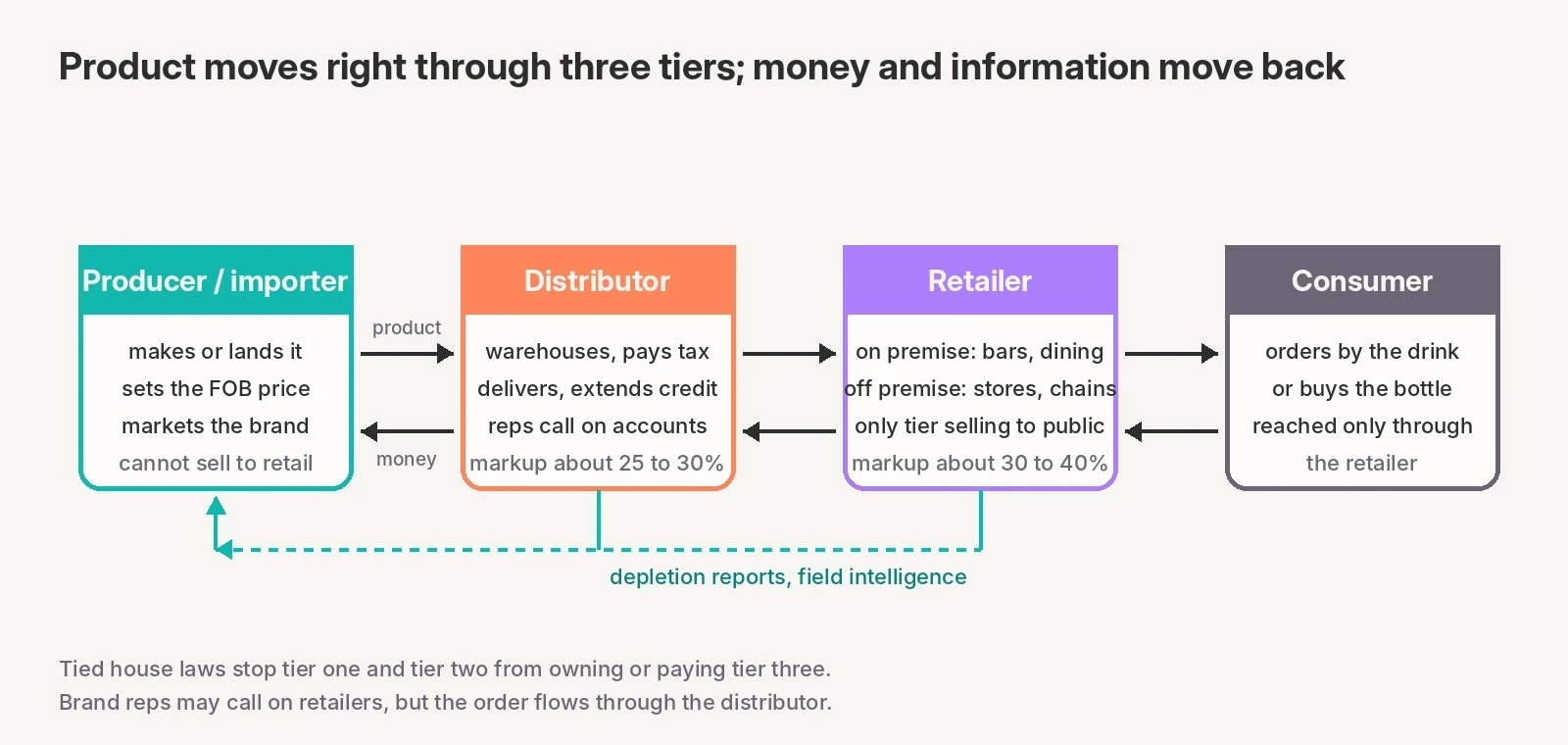
Product moves one way, from producer to distributor to retailer to guest. Money moves the other way, with each tier taking its margin. Information moves back too, but only if someone makes it: the distributor's depletion report tells the producer what sold where, and the brand's own field team is the only source of what the account said, what it pours and what it promised.
What are control states, franchise states and the exceptions?
The three tier shape is national; the rules inside it are set state by state, which is why a brand's route to market is really fifty routes.
Control states. Seventeen US jurisdictions run part of the system themselves. Some, like Pennsylvania and Utah, control both wholesale and retail of spirits through state stores. Others, like Michigan, control wholesale only and let private retailers sell. In a control state the "distributor" conversation is a listing with a state board on a fixed review calendar, pricing is set by formula, and the state's buyers decide which brands get shelf space in state stores.
Franchise states. Roughly a third of states have franchise laws that make a distributor contract very hard to end once signed: the producer must show cause, give long notice, or compensate the distributor to move the brand. Signing with the wrong house in a franchise state is a decision a brand lives with for years, so diligence on the distributor matters most there.
Self distribution. Some states let small producers (craft distillers, breweries, wineries) sell directly to retailers up to a volume cap, which is how many craft brands work their home market in year one before a distributor will take them.
Direct to consumer. Wineries ship to consumers in most states after the Supreme Court's Granholm decision barred discrimination against out of state producers; spirits DTC remains limited to a minority of states and is usually fulfilled through a licensed retailer. Cocktails to go, made permanent in 32 states plus DC since 2020, is a retailer right rather than a producer one.
Washington state. Since 2012 retailers there may buy directly from producers and warehouse their own stock, though exclusive distributor agreements still mean most brands have one distributor in practice.
The practical rule: before entering any state, know whether it is control or open, franchise or not, what it allows for sampling and tastings, and what its tied house rules permit a brand to give an account. A compliance attorney who works those questions is cheaper than learning them from a violation.
What does the three tier system mean for a brand?
That a brand has three different relationships to manage, and that the one it does not control is the one that decides whether it sells.
Who you sell to: the distributor. The distributor is the brand's customer in the legal sense; it buys the cases and pays the invoice. It is also a gatekeeper with thousands of other SKUs, so the brand's job is to make its brand worth the rep's time: evidence of velocity, a named account list, incentives to the distributor's people, and a monthly objective.
Who you sell through: the retailer. The brand cannot invoice a bar or a store, but its reps can and must call on them, because the distributor rep will not build a brand nobody is asking for. The visit, the listing on the menu, the staff training and the follow up are the brand's work; the order itself goes through the distributor.
Who you sell for: the consumer. Reached only through the retailer, which is why the menu listing, the shelf position and the bartender's recommendation are the brand's real advertising. 53% of guests will pay more for a named brand in a cocktail; the brand's job is to be the name.
Why information is the brand's problem. Product and money flow through the tiers automatically. Information does not. The distributor's depletion report arrives weeks later and says what sold, not why. What the account pours, what the buyer said, what was promised and what the competitor is doing exist only if the brand's own people capture them, account by account. A brand that owns that record can direct its distributor, defend its listings and choose its next market; one that does not is guessing. Building that record is what EveryShelf does.
Frequently asked questions
What is the three tier system in alcohol?
The US structure, set up after Prohibition's repeal in 1933, in which producers and importers sell to distributors, distributors sell to retailers, and only retailers sell to consumers, with each tier legally separate.
Why does the three tier system exist?
To stop producers from owning or controlling retailers (the tied house), to make tax collection and regulation workable at the state level, and to give each state control over alcohol within its borders under the 21st Amendment.
How many control states are there?
Seventeen US jurisdictions control the wholesale or retail sale of spirits, including Pennsylvania, Utah, Virginia and Michigan.
Can a spirits brand sell directly to bars?
In most states no; sales to retailers go through a licensed distributor. Some states allow limited self distribution by small producers, and Washington lets retailers buy direct.
Sources
- Wikipedia, Three tier system (alcohol distribution)
- FIVE x 5, Three Tier System Alcohol: How It Works and What It Costs
- Southern Glazer's, What Is the Three Tier System of Alcohol Distribution?
- Park Street, Finding Financial Success in Today's Spirits Market, September 2025
- DISCUS Annual Economic Briefing, February 2026 (cocktails to go in 32 states plus DC)
- NIQ, Getting the Recipe Right for the On Premise Cocktail Opportunity, April 2026